


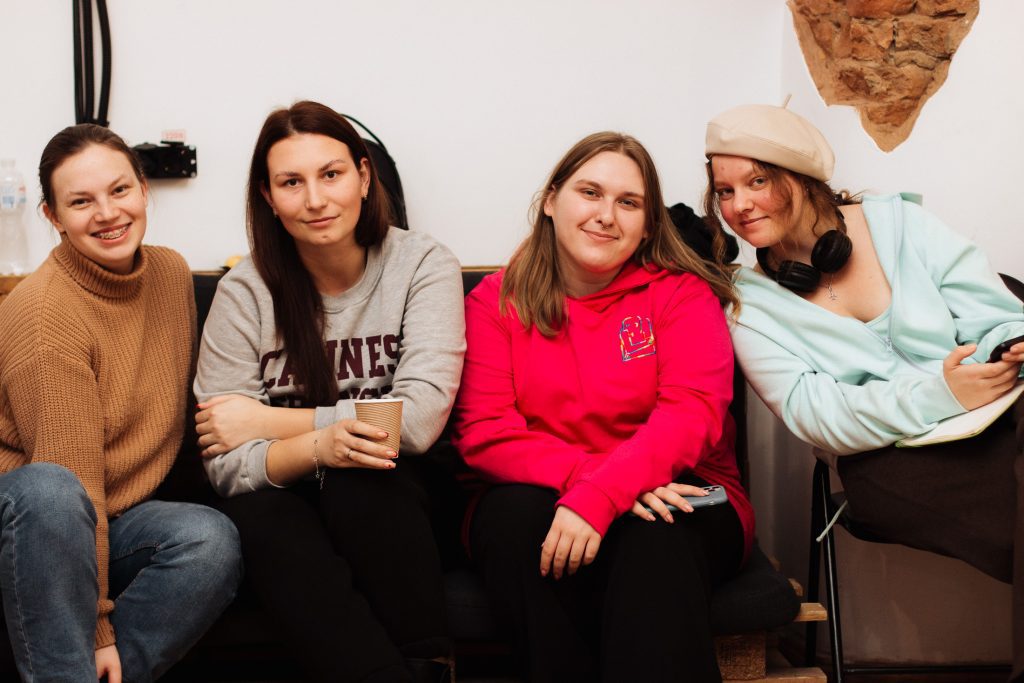
Training of Trainers
29.07.24
“Young Diversity Ambassadors” is a program for people who begin their journey in civic activism. It combines training, practical experience, and building a network of active youth. The program brought together many people who have started collaborating and implementing projects.
Graduating from the program is by no means the end of the story. If the young ambassadors are willing to continue, it is only the beginning, new challenges and opportunities.
One such opportunity is to keep studying in the format of ToT (Training of Trainers). After that, they may become trainers and facilitators, using acquired skills in the work of their organizations, or joining the trainer team of the NGO “STAN”.
Some history
The “Young Diversity Ambassadors” (YDA) program was established in 2019. Back then, the participants could continue their training and work as trainers and facilitators within another project of “STAN”, “The School of Сultural Management”. Now the ToT course is part of the YDA program.
It is also worth noting that YDA has recently joined the international network Global Platforms founded by ActionAid, an alliance for rights, equality, and international solidarity. After that, Ukrainian youth got more opportunities for collaboration with like-minded people across the globe. It has also enriched the study methodology of the program, including ToT, as the organization is now comprehensively adopting the experience and long-standing practices of ActionAid. The first steps in that direction were taken when the STAN trainer team visited the international workshop “Youth Leadership in Emergencies”. Read our previous text to learn more.
One of the cornerstones of both STAN and ActionAid is learning by doing. Practice is essential. After the first training modules, the participants of ToT got a task to hold the workshops in the communities focusing on the topics relevant to them. They also received support from the program. In addition, the trainers put their knowledge into practice at the YDA events, namely at the introductory workshops, where they, too, received mentor support from more experienced colleagues.
How does it work
The first ToT workshop of this learning season was held in Ivano-Frankivsk. The training was combined with city tours and exploration of the environment. The second ToT session took place in Vyzhnytsia, in Bukovyna. The third workshop, last for this year, was organized in the Khata-Maysternia, in the Babyn village in the Carpathians. That’s the location of many events of the program, and we will later return to the topic of these mountain trips.
It is important to mention a few essential things lying at the heart of the training. First of all, a great deal of focus is put on the previous experience of the participants. Say, when the trainer introduces a method or an exercise, they always take into account the group. “The trainers build on the participants’ experience. They ask, “Which exercises do you know? What is relevant for you, what will people like?” explains the trainer and facilitator Solomiya Zinets-Matsyshyn. Solomiya has graduated from the program in 2019. She is now a trainer in the YDA program and is active in her NGO “Triangle”.
It is also important that the exercises were analyzed from different perspectives. “There was a lot of theory that gradually transitioned into practice,” explains Ksenia Ukolova, a participant in the ToT course. “At some point, we looked at the same exercise as both participants and trainers.” Most importantly, they analyzed the purpose of the exercise. “Briefing for the exercise always focused on the question “Why? What do we need it for?” Ksenia shares. “We delved into the smallest details. That made us realize that there are no random elements in the training activities. If something is there, it has its purpose.”
Teaching to lead the workshops and providing the basic information aren’t the only focuses of ToT within the YDA program. It is more than a matter of methodology. Lots of participants share that this training made them understand the role of civic activism. It taught them how to assess the relevance of the problem, to build connections with the community members, and to approach organizational issues. That’s because successful training sessions require a lot of routine preparations. “We have experts on logistics, advertising the event, writing reports,” explains the trainer and the facilitator Yana Malyha. “This way, young people learn both to lead and organize the workshops. That also boosts their skills. They can be trainers, and they can also help in different areas, on different levels.” There are dozens of such examples. The participants often say that in addition to the trainer competencies, ToT has taught them the skills they use in their projects and daily lives. This is true for Anastasia Haliulova, a participant of ToT and the project leader at the Ukrainian Child Rights Network.
Training and life
Anastasia comes from Mariupol. She had spent around one and a half months under occupation. When she finally managed to flee the city, she settled in Ivano-Frankivsk. “I arrived at Ivano-Frankivsk with a huge friend group,” Anastasia Haliulova tells, “and a few weeks after coming to the city we went to STAN. We introduced ourselves and offered our help and skills. That’s how it all began. First I attended the introductory training in Khata-Maysternia. I loved it. When they were enrolling people for the ToT program, I decided I was interested as well. I didn’t know what to expect. I imagined a three-day meeting teaching how to lead a workshop. But it turned out that the ToT training gave me so much more. It made me understand who am I as a trainer and facilitator, what I should do, and how it all should work.”
Anastasia had led workshops and training sessions before. However, she recollects that she did it rather intuitively. The training helped her to analyze her strengths and weaknesses and learn what can be improved. Anastasia is currently engaged in two projects. One of them returns the children who were forcibly deported to Russia or are living in the temporarily occupied territories. The other project focuses on the rehabilitation of these children. “We meet the kids and provide them with full support, from the psychologist to clothes, tablet, or laptop for school (as these families and kids usually arrive with no belongings),” Haliulova explains. “The ToT experience helps me to work with young people. I also use it in my work, as it has taught me how to plan the program, to figure out all the indicators, goals, and timeframes. These skills went beyond training or facilitation and are now part of my life.”
People matter, the program matters
Similar to Anastasia, many young people join the program with the training experience. They also shared that the training gave them a confidence boost and provided a comprehensive approach. “This program brought consistency to my understanding of the trainer work,” says Yevheny Shatilov, a participant in YDA and ToT programs. “Lots of intuitive things were externalized and became part of algorithms: what you are doing, what comes after what. It is also important that we had plenty of teamwork and I got experience working in tandem with many partners.”
“Of course, I expected the theoretical module. I thought we would be told how we should work,” tells a participant Maria Yuakymovytch. “I was surprised how the program focused on values, how it brought us all together. I am not talking about us becoming good colleagues. We are now good friends. The best thing about my collaboration with STAN is the people I met on this journey. It was the most valuable, and I love how other people’s experience has made me better.”
How capable we are
We have already mentioned that the YDA program holds the majority of workshops, including Training of Trainers, in the Khata-Maysternia in the mountains. Even getting up there is a challenge in itself. “Some people arrive and say, “Ascending is too complicated. I’m exhausted, I can’t do it,” Yana Malyha explains. “But when they put in some effort, they realize the importance of every step on your way to a dream. The group’s support and realization “Everyone can do it, and so can I” are also crucial. It boosts your self-esteem.”
Yana Malyha tells how great it is that the Khata-Maysternua is isolated from the hubbub of the cities. You can be fully focused here. “Here you understand how nature and everything around you can restore your energy,” Yana says. “You think about your mental health. About not getting lost in the war. About working at your well-being in the given conditions and not waiting for the better times and delaying your life.”
When the weather is nice, the training participants and the organizers climb the Sokilsky Ridge, beneath the slopes of which Khata is located. It is just as important as the training modules themselves. “When they are ascending,” Yana Malyha says, “They talk about realizing that actually they can do so much more than they allow themselves to dream. The limits are in our minds. That too comes as a revelation. At times the young people don’t truly know themselves, not aware how capable they are of doing something and changing things for the better.”
The project “A network for democracy: Building a future with the European leaders of tomorrow” is implemented by the NGO “STAN” and ActionAid in partnership with the NGO “Center for Social Transformations TENET”, NGO “Insight”, NGO “Chernivtsi Association “Zakhyst” with the support of the Danish Ministry of Foreign Affairs (Denmark). This project is a part of the program “Young Diversity Ambassadors”
This is a program for youth and youth workers to strengthen social cohesion to create an inclusive, peaceful society, minimize the likelihood of conflicts arising between different groups, and accelerate the integration of young IDPs. The program is implemented by the NGO “STAN” in partnership with the Alliance for Rights, Equality and International Solidarity “ActionAid” with the support of the Disasters Emergency Committee (DEC), Global Fund for Children (USA), Terre Des Hommes (Germany) and IM Swedish Development Partner (Sweden).