


Awareness against fear
04.03.25
Young Diversity Ambassadors projects focusing on gender equality, feminism, leadership, and LGBTQI+ rights
We live in a society where gender equality and respect for diversity are not a status quo but rather a long-term goal. Many people are wary about the LGBT community or feminism, as they can’t fully grasp these ideas. Some perceive the former as 50 shades of lewdness, and the latter, as the offensive of militant women. Unfortunately, it’s not a joke. The repercussions of such misconceptions are not funny either, as they often lead to discrimination or physical violence.
We are but people, and we are afraid of darkness. Darkness hides the unknown. That’s in our nature: when we don’t know something, when we can’t see something clearly, we make up monsters lurking in the shadows. If someone acts aggressively towards feminism or Pride parades, in most cases they are afraid of the unknown. “What is our problem? Lack of awareness,” muses Olena Hryhoriak, an expert in the LGBTQI+ community, gender equality, and feminism, and trainer of the “Young Diversity Ambassadors” program. “Awareness and education help to develop critical thinking. It helps to understand how these things allow us to live freely, free of fear. Otherwise, you’ll “have” to fear all the time. Afraid of a Romani person or a gay person… Awareness is crucial because it makes you understand: you don’t need to be afraid of the unknown.”
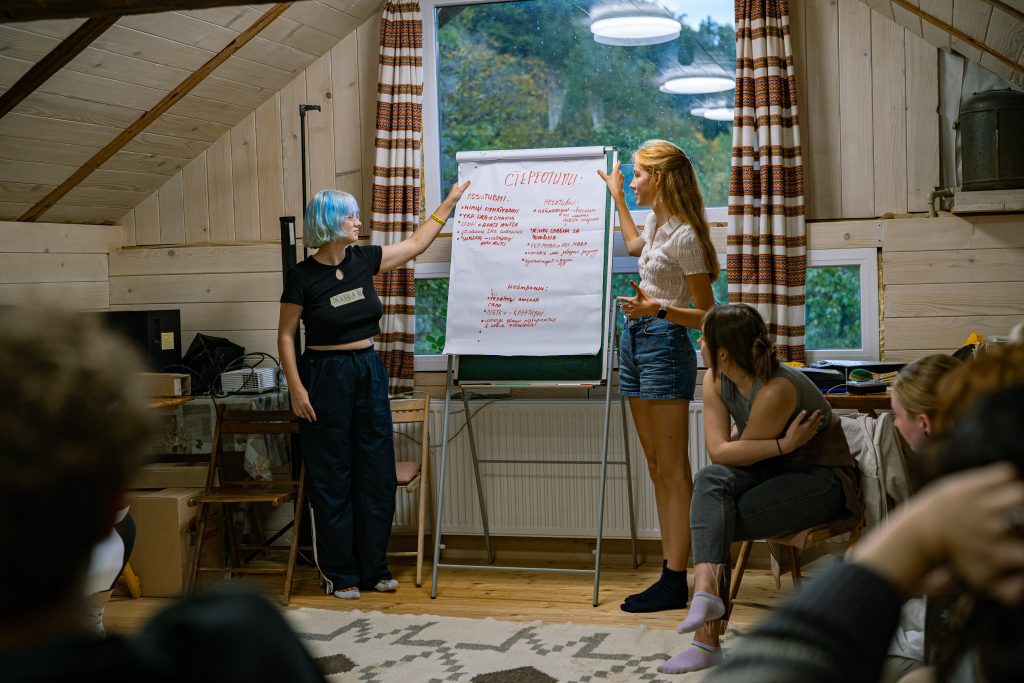
In addition to being the YDA trainer, Olena Hryhoriak also works as a coordinator of the Chernivtsi branch of the NGO “Insight”. The organization has extensive experience protecting the rights of LGBTQI+ people. Now this experience is being shared with the participants of the Young Diversity Ambassadors program. At the workshops, young people learn and develop their ideas receiving mentor support from their more seasoned colleagues. Young activists can get grant funding to implement their ideas in the program. As a result, more new projects and initiatives are conceived. They tackle the previously underrepresented issues. It is communication and dialogue that we can use to combat a lack of awareness. We will talk about several projects, explaining how important is learning for activism, and activism for learning.
MePower and honoring the diversity
One of the most impressive educational media projects focusing on gender equality, LGBTQI+ rights, and feminism implemented within the YDA program, is the MePower application. This media platform collects educational materials, news, announcements, and info on grants and opportunities for women and communities at risk. You can download the application from Google Play, and soon it will be also available on AppStore. “At first we stuck to the topic of feminism,” says Olha Kapets, a member of the Me.We.Women team. “Gradually, we have added information on the LGBTQIA+ community and other vulnerable groups, working with stigmatized topics, such as sex ed, and debunking the stereotypes.”
The app also contains information useful for people in need of psychological support or under difficult circumstances. This includes useful links and hotline contacts accessible to the widest audience. “Respecting diversity is the core value of our team,” Olha concludes, “and the application engenders this diversity. Our goal was not to speak only about white or cisgender women, but about all women, all while applying the complex approach to studying their problems. This point is the most integral. We strive to speak about everyone, regardless of their identity or status.”
The creators of the application are convinced that MePower may become an alternative for people relying on messenger groups for information. “Many people, particularly from the civic sector, are currently using Telegram,” Olha muses. “They are subscribed to the channels telling about opportunities and grants. As far as we know from the news, in a few months Telegram may no longer be active. Our application may become a replacement, namely, for the platforms people use to search for opportunities.
“Feminism”, “masculism”, and what is behind these ideas
Roksolana Stakhniv is an alumna of the Young Diversity Ambassadors program and the project manager of the youth center “Hyzhka” in the city of Dolyna, Ivano-Frankivsk region. This year, she has implemented the project “How to be a man in my community” within the YDA program together with the youth center team. It doesn’t seem like a problem at first: just be a man, what’s about it? But actually, gender stereotypes prevent boys and men from engaging in civic activism.
The story of this initiative began in 2022 when the Hyzhka team had been implementing the Gender Balance project. “The project was successful,” Roksolana Stakhiv says, “Still, the boys at the training either knew the team before, or they were brought by a friend and didn’t quite understand what it was about. After the workshop, girls changed their values and became more active. However, this was not the case for the boys. The problem with our town is that the boys are not actively involved in the youth politics, especially in such areas as gender equality and social inclusion, work with the IDPs.”
The Hyzhka team has conducted a survey and realized: many boys in the community are outraged by masculism, which, in their opinion, prevents people from aspiring to become stronger and more resilient or go to the gym. It was not only evident from the survey. Roksolana says, that during the work on the previous projects focusing on the stereotypes around men and women, some boys explicitly deemed these topics unacceptable. “Even though these were minor cases, they were frequent,” she says. “The boys said: we already know how it will go. Once again, we will be told that women are equal members of society that deserve respect. What’s new about this?” There were also threats. “Just you dare return to us with the projects about gender equality and social inclusion, and we’ll toss protein jars at you.”
There is another side of the coin. According to Roksolana, sometimes young men came to “Hyzhka” with the project ideas. “We told we could help,” she said, “but then they fell away. They lacked courage. Told they didn’t want to get involved. Got the impression that we would organize everything for ourselves.” It is obvious that if they come up with the ideas, it means they care. They would love to engage, but something stands in the way. That’s why the “Hyzhka” team keeps working with the topic of gender stereotypes, and as part of YDA they developed and implemented the project “How to be a man in my community.” “If “Gender Balance” was a first step, why shouldn’t we keep up working with this topic?” the project manager muses.
This time they decided to go deeper and be more thorough in connecting to the audience. They created a communication strategy, spoke to the representatives of schools, and told them about upcoming events. The team explained that they are not limited to the concepts of “masculism” or “feminism” and in reality, the topic is more complicated and multidimensional: it’s a matter of human rights and non-discrimination, about the ways everyone can change community life. In addition, they planned to hold workshops in the town schools, which allowed us to reach a wider and more diverse audience beyond the Hyzhka space.
“The ‘How to be a man in my community’ initiative strives to deal with sensitive issues and foster a safe space for expressing your opinions,” Roksolana Stakhniv explains, “It’s an attempt to teach leadership, critical thinking, and combatting the discrimination.”
To work or to study
Roksolana says that she joined the “Young Diversity Ambassadors” program in March 2024, when she first attended the workshop in Khata-Maysternia. It wasn’t a simple decision, but it marked the beginning of a profound transformation. “Initially I was met with a dilemma,” tells the project manager of Khyzhka. “At the time, the youth center was concluding one of our previous projects, ConnectiOn. I was faced with a tough choice: I was either supposed to stay with a team and meet the donors or get the opportunity to return to study and challenge myself. I was torn by doubts, pondering if it was the right decision for me, the team, and the center. In the end, I decided to give myself a chance, because I understood: my self-improvement and self-actualization would help the youth center to move further.”
Time has shown that it was the right decision. It turned out that it was not necessarily an “or-or” decision, and the study doesn’t get in the way of work, volunteering, or civic activism. Furthermore, it is hard to imagine work or the productive development of the organization without constant learning. It works both ways: isn’t learning without practice worthless? The former supports the latter, and vice versa. They provide new skills, friendships, and new partnerships. “At the workshop, I realized what it means to work in a team,” Roksolana muses. “It’s not only about getting tasks and doing them individually. It’s a matter of communal creation of ideas, collaboration, and adding to each other thoughts. I also value the mentor experience I acquired and the core principles of leadership, collaboration, and social inclusion I understood. I realized that friendship may entail spending a good time together and providing connections useful for the implementation of ideas and initiatives. In my opinion, the most important thing Young Diversity Ambassadors have taught me is trust and cherishing friend bonds”.
The project “A network for democracy: Building a future with the European leaders of tomorrow” is implemented by the NGO “STAN” and ActionAid in partnership with the NGO “Center for Social Transformations TENET”, NGO “Insight”, NGO “Chernivtsi Association “Zakhyst” with the support of the Danish Ministry of Foreign Affairs (Denmark). This project is a part of the program “Young Diversity Ambassadors”
This is a program for youth and youth workers to strengthen social cohesion to create an inclusive, peaceful society, minimize the likelihood of conflicts arising between different groups, and accelerate the integration of young IDPs. The program is implemented by the NGO “STAN” in partnership with the Alliance for Rights, Equality and International Solidarity “ActionAid” with the support of the Disasters Emergency Committee (DEC), Global Fund for Children (USA), Terre Des Hommes (Germany) and IM Swedish Development Partner (Sweden).