


Path to the Future
17.07.23
Since the fall of 2022, within the “Crisis Response in Ukraine” project child-friendly spaces were opened in four towns of Ivano-Frankivsk Oblast (Kolomyya, Nadvirna, Vorokhta, Burshtyn) and the village of Lukavtsi in Chernivtsi Oblast. CFSs are spaces where children can study and enjoy spending time.
The first months were tough. While the renovation works in coming child-friendly spaces were ongoing, facilitators and psychologists worked with kids in the alternative spaces. Together with parents and kids, they created a warm and safe environment. Often, when Russia was attacking the Ukrainian energy infrastructure, CFSs worked without electricity and heating.
In spring, the work of CFSs has normalized. Children are spending time now in the newly renovated buildings, they use laptops and projectors and play board games. There are tennis tables, new books in the spaces’ libraries, and many other things. Taking for example Burshtyn and Lukavtsi child-friendly spaces, this text tells about the current state of affairs in the CFSs and what should be expected in future.
Books, computers, and movies
The “Crisis Response in Ukraine” project is implemented by STAN NGO in partnership and with the financial support of the Czech humanitarian organization People in Need (PeopleinNeedUkraine). Within the project, psychological support for children, their parents, and guardians is available in CFSs, as well as activities with facilitators.
There are many new activities. For instance, in winter shadow theater was started in Burshtyn, and now a readers club has been founded in the space. Children read, invent their own stories, and then transform them into a theater of light and shade.
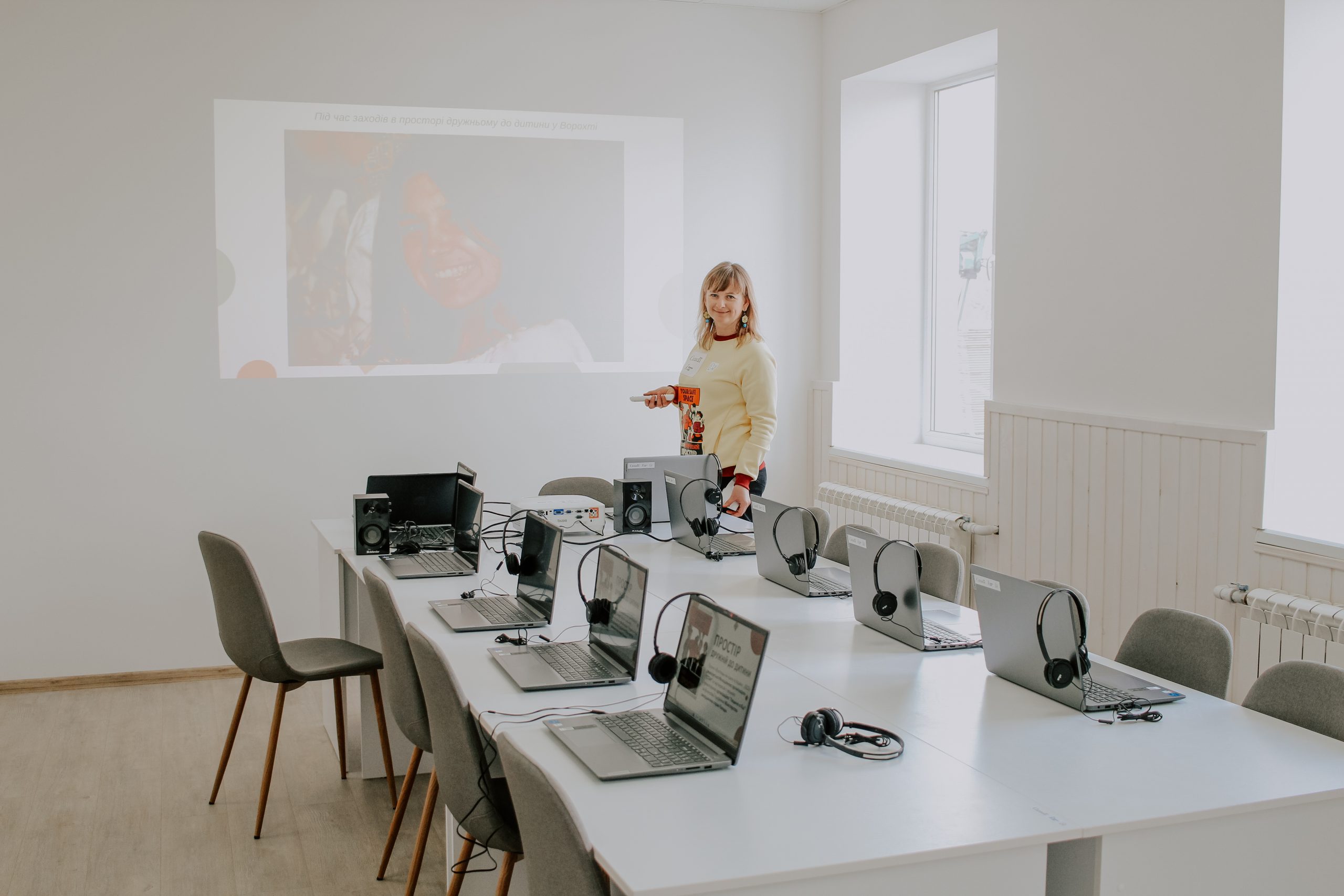
Every space now has a digital cluster with laptops, a projector, and a printer. This provided the opportunities the space had not had before. “We organize media literacy training, preparing classes with videos in an interesting for children format”, says Tetyana Zarivna, Burshtyn CFS administrator.
Quite similar work has been organized in Lukavtsi CFS. Along with sightseeing tours, financial literacy lessons, and environmental awareness training, new activities have been added that would be impossible without the equipment. During computer classes, children learn to create presentations and work with text editors. They also watch cartoons.
“We’re in a fully equipped space now. We have equipment, stationery, and board games. Everything that the heart desires. We have a projector and organize screenings on a large screen on Fridays. There is always a cooking moment before the screening. Children cook some food to eat while they watch, like pizza. They even baked bagels”, says Kateryna Stazhyr, Lukavtsi CFS’s administrator.
They are planning to organize documentary film screenings in the space from the Docudays human rights festival.
“There is a request to watch a movie about bullying prevention. We need to discuss in the communities that bullying is not OK. Children need to understand they don’t have to tolerate when someone bullies them. Not only children, teachers, parents, and everyone who works with children also needs to understand this”, says Andrii Volyk, media manager at STAN.

“Act and Change”
One of child-friendly spaces aims is to help IDPs get integrated into new communities. That’s why many integrational activities were organized at the beginning of the program. Local and internally displaced children and adults participated in them. They prepared activities together, worried together, and had a perfect chance to meet not “some locals” or “some IDPs” but simply friends.
Now this approach has been improved.
“We decided to give a chance for youth, teenagers who live in this town, IDPs among them, to get organized and do something for themselves. And at first, they had to be taught how to do this. To provide them with resources to implement their initiatives and understand they can try things, can develop themselves and improve life in their community”, says Yulia Menshakova, the “Crisis Response in Ukraine” coordinator.
The first step in this direction was cooperation with the Young Diversity Ambassadors program STAN is implementing. The aim was to educate and support young activists. The program offers four thematic workshops: environmental awareness; decolonization and memory; feminism, gender equality, and LGBTQI+ rights; art, culture, and human rights. After the training, participants can apply for mini-grants for the implementation of their ideas.
Such a model was also a basis for the “Act and Change “ youth initiatives workshop within the project “Crisis Response in Ukraine”. Facilitators from the Young Diversity Ambassadors program conducted three-day workshops in CFSs. With the youth, they discussed how the topics mentioned above are relevant to their communities, and how these issues can be addressed. Later, additional project design and project management training took place in child-friendly spaces.
After these education stages, youth from Burshtyn, Lukavtsi, Kolomyya, Nadvirna, and Vorokhta will be able to receive financial support for implementation of their initiatives. One project will be selected from each community.

What unites us
“Act and Change” program connected diverse people. Some of them are very young, and others are already university students. There are people with different experiences and interests, and this is their advantage. It helps to go beyond the established notions and to look at the world from different angles.
“Many different people. Younger, older, boys and girls. And we together have reached a common point. This is the most precious. There are many problems in our community, and together we came to understand what these problems are. One person knew about one single issue, another – about another one. We shared. And this is so cool when you can talk freely! Not to be afraid of expressing your thoughts. Everyone mentioned this is very important”, says Yuliya Myroniuk, one of the workshop participants in Lukavtsi.
This is indeed important. In a healthy environment, people can listen to others and respect others’ views. No matter how different the views are, people must agree on certain things like respecting human rights and the value of diversity. And then people can always find things that unite, find ways to cooperate.
“The topic of tolerance has always been important to me. We talked a lot about it. And about respect and mutual understanding too. Accepting someone does not mean abandoning your beliefs or giving up. Being tolerant means in the first place being strong and humane”, says Yuliya Deisak, a participant from Burshtyn.
The program allowed the youth to talk over topics that had not yet been loud in the communities. “I wanted something new”, Yuliya continued. “I wanted communication, to see like-minded people. I also wanted to look at certain topics from another perspective. To learn more about decolonization and memory, art, ecology, and gender equality. These are the topics we normally don’t discuss here. Gender equality is not discussed at all. Teenagers cannot talk with their parents about certain things. We said at the end of the workshop: ‘Thank you for talking about this’”.

Youth decides
“Act and Change” activities gathered young people, and some of them had not visited CFSs or even had not known about them.
“Children are brought by their parents, and youth decide for themselves whether to stay in the space or not. What we have in spaces now will allow us to get acquainted not only with children but also youth with our platform. These spaces are community property. We want them to stay a platform for uniting activists and local authorities. So that the doors won’t be shut and left in the hands of the local authorities. We want this synergy of town councils and activists to be long-lasting”, says Olha Symchych, head of the CFS program within the “Crisis Response in Ukraine program”.
Yulia Menshakova is convinced the “Act and Change” program will have a huge impact even after its ending. “The youth will understand how it works. They will be able to look for resources independently, to organize interesting events or projects. We’ve started laying a path to the future. We create such hubs in different towns, and they have to be magnets for active people. So that when we leave, young activists and volunteers would stay”, says Yulia.
Maybe this is Yulia Deisak’s case. She studies Social work and social pedagogy at the Vasyl Stefanyk University in Ivano-Frankivsk. The subject of working with children interests her, and she is also interested in her colleagues’ experiences. Yulia had been following the spaces’ work in Telegram, but the “Act and Change” program became a push. Yulia took part in the workshops and this helped her to become better acquainted with the space, and first of all to understand the problematic issues in her town and start cooperating with other young people of Burshtyn.