


Support that makes one more resilient
31.05.23
Ukrainians were fleeing the war-torn cities, trying to save their lives. Some had time to think it over and pack a bag, while others just ran out the door to get a bus or train and move as far from the war as possible. People had to start from scratch at new, safer places. They had to think about basic needs: a roof over their heads, food, and where to get money for living. It’s important not to leave the internally displaced people alone with these issues. This text shows the importance of crisis response and its varieties. It also traces the idea of what this response could be in the future.
Not a spontaneous help
People found themselves in cities and towns without their former neighbors, and yet without friends. They lost connection with everything they were standing on, with things that used to give them confidence. The importance of a supportive shoulder in such a situation cannot be overestimated. That’s why STAN with partners and donors tried to react quickly to the IDPs’ needs.

Since the first days of the full-scale invasion, volunteers were at the train station, meeting people, welcoming them, providing food and hot drinks, helping with the accommodation and food. The STAN team with the partners and donors provided shelters with everything that was needed: from food to furniture and household appliances.
Russia’s full-scale invasion is not a natural disaster that comes suddenly and suddenly goes away. The war has been ongoing for nine years, more than a year has passed since the full-scale invasion started. Ukrainians are standing, and only getting stronger. And support for those in need is getting less spontaneous and more organized.
Considering the needs
Since the fall of 2022, Hilfswerk International, in partnership with STAN NGO and Moldovan organizations “Gender-centru” and “Moştenitorii” has been implementing the project “Emergency relief and protection of conflict-affected IDPs in Ukraine and Ukrainian refugees in Moldova”. The project is aimed at contributing to providing humanitarian aid for people who suffered from Russian aggression. It also aims at providing psychosocial support and gender-specific protection for IDPs. However, the most basic and the first needs are food and a place to live. That’s why the STAN team started by equipping shelters and providing food sets for their residents.
The experience of other humanitarian organizations and foundations was taken into account. The team was working to understand what products people get less often.

“There already has been pasta, cereal, flour. And we’ve added fish, meat, oil, and some sweets to the sets. We’ve seen that not many standard food sets have them. And people often said to us they have had enough cereals or pasta, but nothing to put on a plate next to them”, says Marichka Keliy, operational manager at STAN NGO.
STAN created an online form to collect feedback on how they could improve the food sets. They also received feedback through the shelters’ coordinates who communicate a lot with food sets recipients. Next food sets were improved according to all those comments.
Without heating and electricity
Delivery of hot meals was started in Zaporizhzhia in the framework of this project. Many IDPs live in the student dormitories in the city, and among them are students from the occupied areas and the frontline towns. They cannot come back home now. Since the students are registered in the dormitories of Zaporizhzhia, not in their hometowns, they cannot receive an IDP status and cannot claim for help.
When STAN NGO and partners became aware of this situation, they decided to provide hot meals for people in the dormitories. It was a time when electricity cuts happened every day, water and heating cuts came together. That’s why people had a difficult time with cooking.
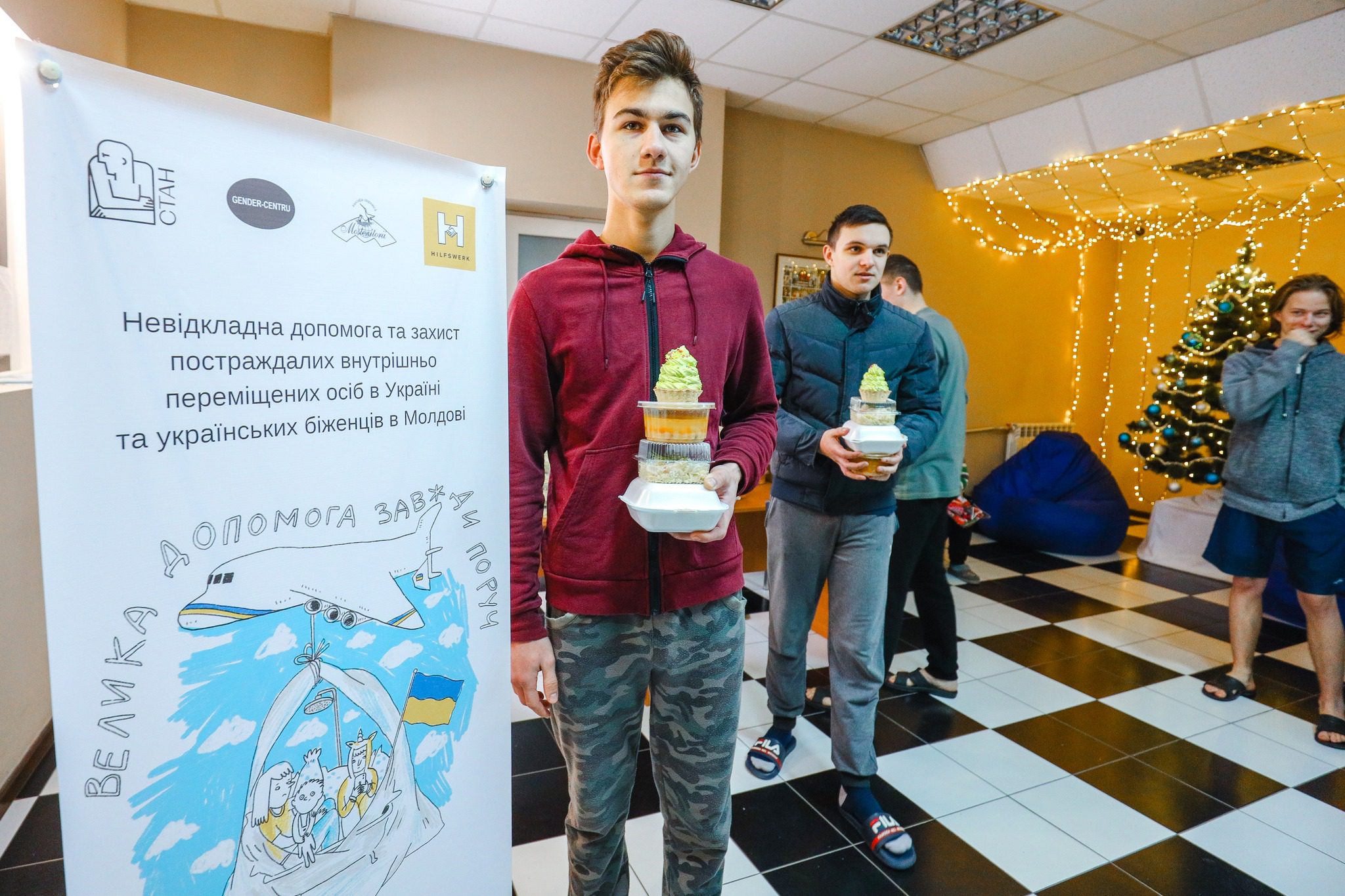
“Every day we distribute 360 portions in five dormitories. The Ukrainian Future charity is our partner in Zaporizhzhia. We give ready meals: soup, main course and bread. People have got around 20 000 portions by now. There is a need, and we work to engage more resources and continue to provide this help”, says Marichka Keliy, operational manager at STAN NGO.
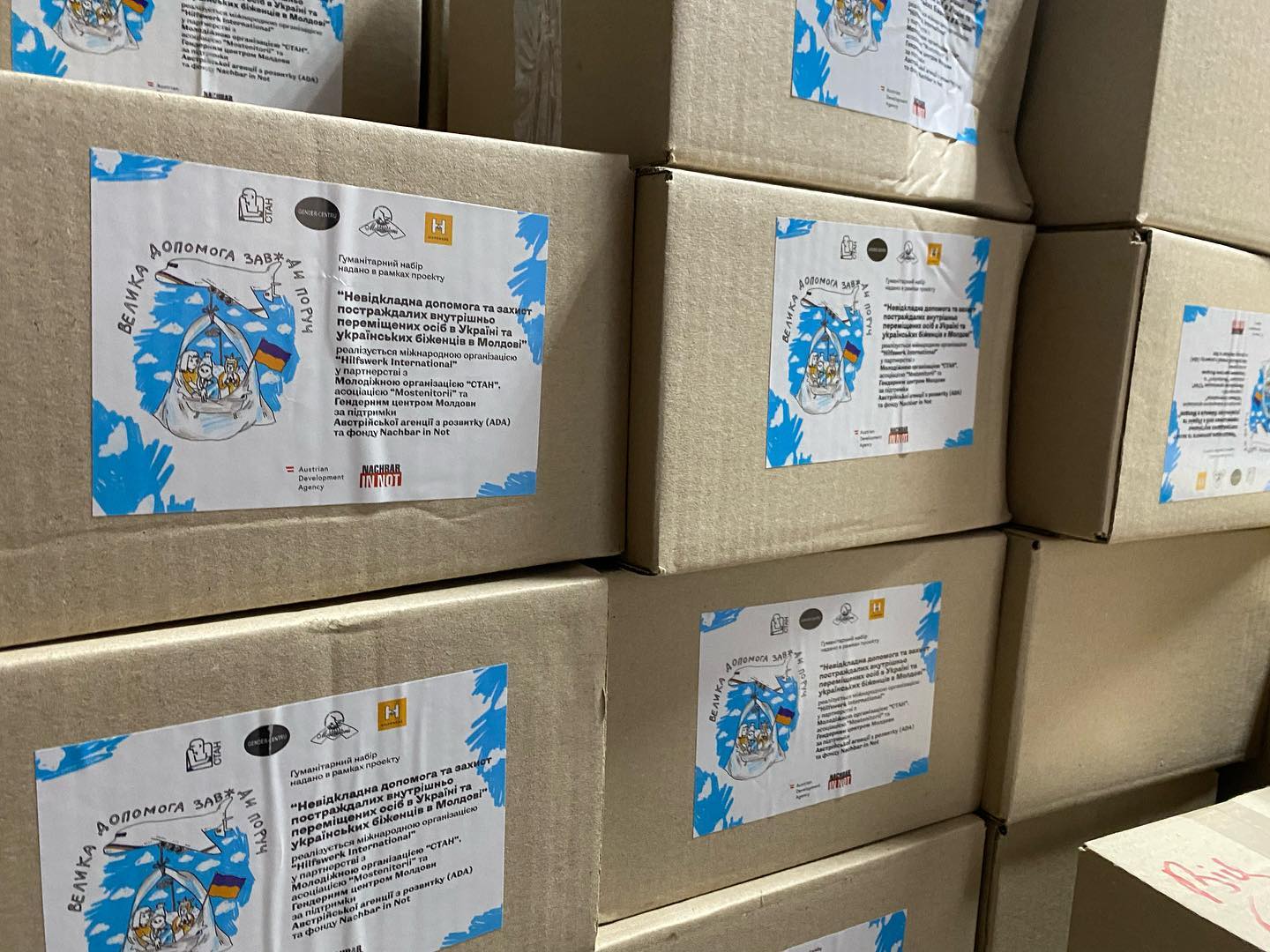
Beyond food, STAN NGO with partners has distributed 3000 non-food sets (hygiene items, washing powders, etc.) and 2000 women’s dignity sets.
“There is a project component focused on women’s support. We worked on adding to the sets of necessary things that are not provided by other organizations. We’ve got feedback from women that the sets are organized with an understanding of their needs. Indeed, when they were fleeing the war, nobody thought about mirrors, manicure sets, or hairbrushes”, says Keliy.
A lot of attention was paid to the list of items and their quality.
“Household chemicals from Hifswerk were of very good quality in every set. There are female hygiene sets, and manicure sets. And also food sets where you can find cereals, butter, sugar, canned food”, says Hanna Sokolova who lives in Lysets shelter.
Walls and humans
Shelters for IDPs started on the first day of Russia’s full-scale invasion. STAN NGO was involved in their establishing and providing for them. Currently, in the framework of the mentioned above project with HWI, STAN supports ten such shelters. Some of them are focused on supporting the most vulnerable groups among the IDPs. Such as a shelter for the LGBTQI community in Zakarpattia and a shelter in the Hrabovets village (Ivano-Frankivsk oblast) that hosts 14 persons with disabilities.
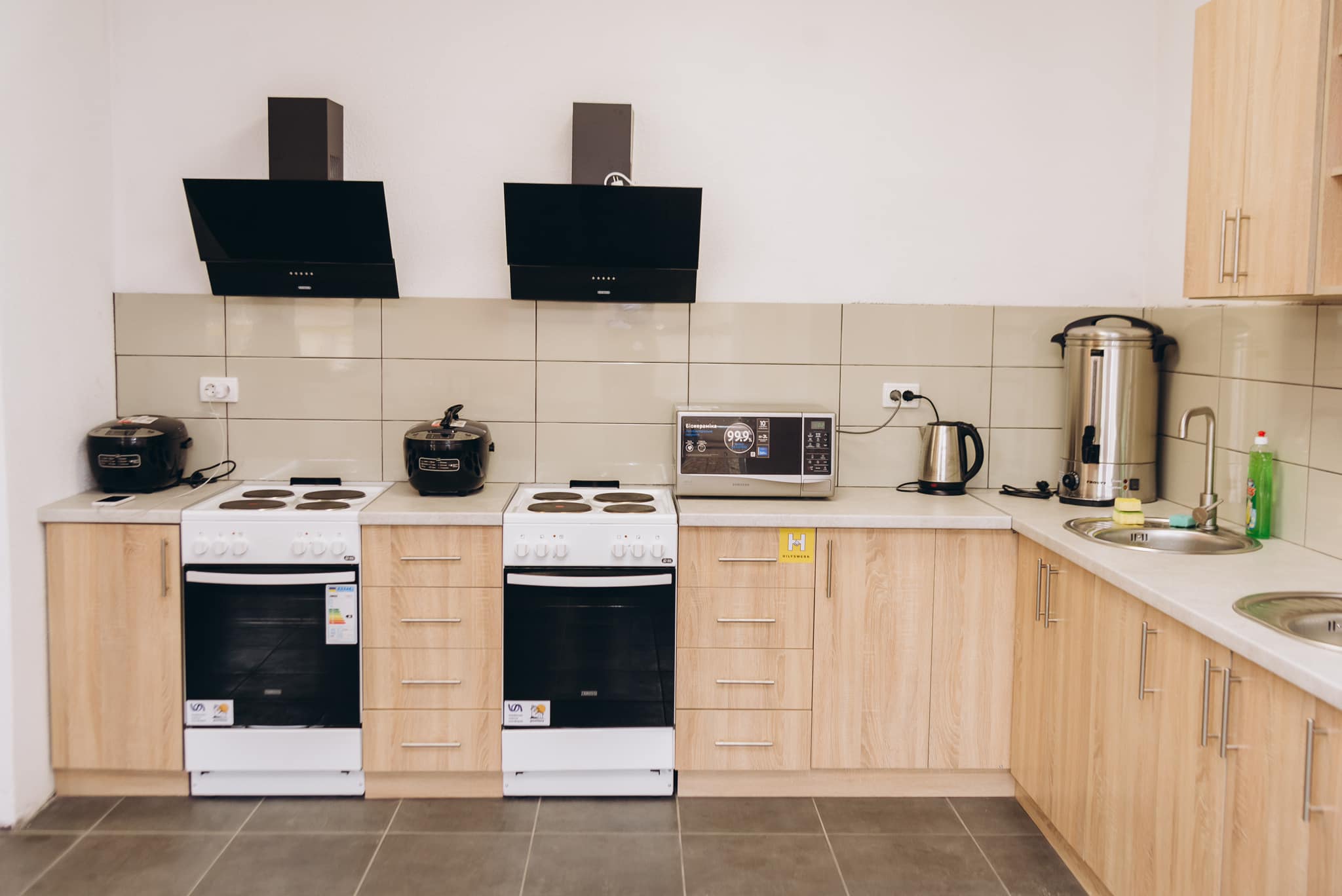
Ten shelters got necessary improvements in the framework of the project. For instance, in Lukavtsi shelter in Chernivtsi oblast STAN NGO has helped with the heating system, in the LGBTQI shelter the old roof was renewed. STAN NGO and partners worked to provide temporary shelters for the IDPs, and secured decent living conditions in those shelters. Besides this, they compensate the expenses for routine repairs, keeping the territory, and to a large extent the household bills. However, it is not good to deprive people of the responsibility for a space where they live. Such deprivation leads to a syndrome of learned helplessness. In other words, this means getting used to being strengthless, and losing initiative and self-confidence. So, they have to pay bills at least partially.
“After being under stress, a person needs to get involved in some activity. If all your functions are carried out for you, why would you get rid of stress? That’s why we had a condition for everyone who wanted to live in the shelter – people had to help arrange the space”, says Kateryna Stazhyr, Lukavtsi shelter coordinator. Also, it was agreed among the residents and coordinators that in Lukavtsi people would pay electricity bills.
Shelters administrators are more and more often thinking about transforming shelters into some kind of rehabilitation centers, so that people would see them as just a temporary accommodations, and the shelters would be spaces to get new knowledge and skills, resources to move on. Such changes would mean investing “not in walls but in people”, says Marichka Keliy.
Beehive
Meanwhile, in the Beehive shelter that was opened in Kolomyya in early March, a lot had to be “invested in walls” in the beginning. A heating system, kitchen furniture and sanitary ware were mounted in the shelter with the support of HWI. However, this is not the main aim, only providing an appropriate level of living conditions.

“This is more than a family-friendly hostel for us. This is a place for interaction and socialization. We will communicate with every family about their needs and make a plan for their development. Employment experts will teach how to make a good CV, how to behave at a job interview. We also plan to help people to learn new professions and motivate local and displaced businesses to employ IDPs. People with diverse knowledge arrived here, we now have specialists in the fields we haven’t had before,” says Solomiya Zinets-Matsyshyn, head of “Trykutnyk” NGO and shelter’s co-founder and coordinator. She is sure this will give a boost for businesses.
There is a successful case of such cooperation already. Fedir Khomyak was born in Kolomyya but has spent almost his entire life in Kherson, creating a family there. Fedir is a merchant fleet sailor, he worked in an international company. After the occupation of Kherson he managed to get out of the city, and he came back to Kolomyya. His profession is not needed onshore, as he says, so he faced hardship while searching for a new job. “Trykutnyk” NGO team contacted him with a relocated business from Kramatorsk – a workshop that makes knives, for the UAF too. This is not a job in his field but it helps Fedir to move on.
“They called me back often and asked how they could help. They gave me a number for the place where I work now. I started working, looked at what people were making in this workshop and understood this is a kind of art. It’s a good feeling to be part of a craft that inspires, especially now”, says Fedir Khomyak.
Living on
No doubt, people need to be able to satisfy their basic needs: to have a place to sleep, to cook food, to be able to pay their bills. Yet, a person cannot constantly live in survival mode, and rely on external help. Sooner, or later one has to make next steps.
On the other hand, such help (humanitarian support, psychosocial one and the shelters) exists only to become unnecessary one day. IDPs have to stand on their feet some day and be able to live without that support, to find a job, to rent a separate space and provide for themselves. They need to start feeling confident one day.

We shouldn’t forget that shelters and food sets are forced temporalities. They are crutches that should be thrown away. It’s good they are available. But their best purpose is to help one to withstand and to say “Thank you, I don’t need this anymore. Further on I will be on my own”.