


Young Diversity Ambassadors. What Is Ours And What Was Imposed on Us
28.08.23
At the decisive stage of the Young Ambassadors Program, its participants implemented their initiatives in the framework of several defined topics. We’ve already written about them in a previous article.
Decolonization and thinking of memory for the future were the topics young people liked the most. This is not a surprise since Ukraine now is fighting for its independence and firmly as never before saying goodbye to its colonial heritage. It is rethinking its past, shaping new visions of the future.
The way we will be rebuilding our country after the victory depends on these thoughts. The reference points we would have and the values we would rely on. And the country we will finally live in.
From the foundations
Tomorrow’s Ukraine is neither a manna from heaven nor a birthday gift from an auntie. It will be exactly how we will restore it, or sometimes re-build, or create from the foundations. From the foundations, because from scratch is not possible. Many centuries are behind us, experience and memory are behind us. They influence us whether we want this or not. We cannot erase anything, and cannot pretend it didn’t happen. However, we can rethink. To understand what is important for us as a society and what is harmful. What’s ours and what was imposed on us.

When we get rid of the colonial heritage, we clean a place for something new to come. It’s about a vision for the whole country. And about historical figures that the empire tried to take away from us. And about understanding the value of every region. These thoughts were the loudest in the initiatives about memory and decolonization implemented by the participants of the Young Diversity Ambassadors program. The most interesting ones are described below.
Home you cannot forget
The “Portraits of the Luhansk Region” project presents ten interviews with people who were forced to leave Luhansk Oblast due to Russia’s full-scale invasion. Their cities and towns are temporarily under Russian occupation, and some, like Popasna, are destroyed. But people keep some fragments of their home, some fragments they could preserve. Some memories about cities and people. Or things they took with them in a situation they could take only the most necessary.
These are sincere, poignant interviews. They tell about life in Luhansk and Severodonetsk, Popasna and other cities and towns. About traditions, both ethnic and of every family. About a grandfather, who showed a city to his granddaughter, about a school where Ukrainian songs were performed even when the Russians were already in the city.
These are light, optimistic stories. On the one hand, they draw a personal picture of every person, and all together they shape a portrait of the Luhansk region. This portrait is interesting for those who left the region and for those who have never visited it. And here is one more value of this initiative: these interviews help to learn more about the region, and get rid of some false myths and stereotypes.
Even a project’s team has learned a lot from these interviews, especially the team members who come from other parts of Ukraine.
“We also had a stereotyped vision of the Luhansk region. But during the implementation of the project, we learned it has many peculiarities, a unique history, and traditions not many people know about. For instance, a woman who has been a chorus singer during her whole life told about traditional songs that were sung at specific holidays, and what Christmas carols were sung in the region. These are the carols of the Luhansk Oblast. And this was a discovery for me. We don’t know about so many things that exist next to us. And it is within our power to preserve and share what we have”, says Yuliia Bondarenko who is doing communications for the project.
Diverse people told their stories for the project. A chorister, an artist, a florist from Severodonetsk, a philologist from Popasna, and an IT department student from Luhansk. All these people are dreaming of coming back because Luhansk, like every other region of Ukraine, is unique and indispensable.
“I have a feeling of space in the Luhansk region. And I think a special breadth of your views, and love of freedom is shaped only in the Ukrainian steppes. I want to pass this on to my students. The true Ukrainian language is not only in the west of Ukraine or somewhere near Kyiv – it’s everywhere, in every corner of the country. We should stop competing on who is better Ukrainian, who speaks more pure Ukrainian language, or who has more traditions. Every region has brought its assets to the whole Ukrainian culture and nation. And the love of freedom is from the East-Ukrainians”, says Ksenia, PhD in Philology.
People who aren’t forgotten
Myroslava Horobchuk was a curator of “M-Formation” Youth center in Berdychiv when she got into the Young Diversity Ambassadors program. She was also the head of a reading room in a library where M-Formation is located. Myroslava had thought a lot about how she could make reading more popular among teenagers. Once she found a TikTok channel where a girl recreated pictures of famous personalities. She decided to develop this idea and recreate with teenagers famous photos of Ukrainian artists and along with that organize evenings where participants would talk about their figures. This is a way to make teenagers learn more about those famous people, read something, and look for props for photos. And ideally, to register this somehow.
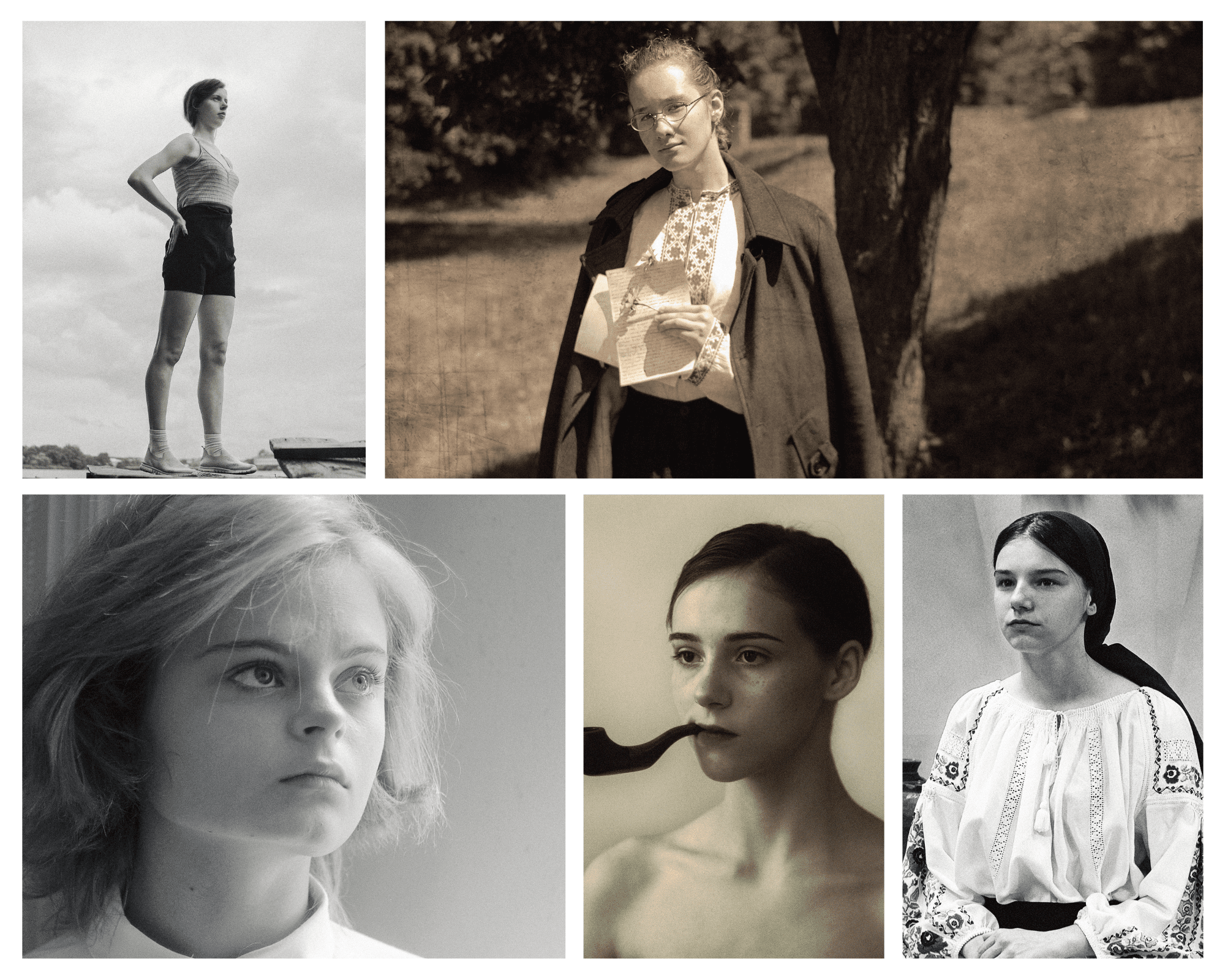
So they created a Zoomer zine called “Unforgotten”. The title comes from the fact the historical figures they were dealing with are less famous, and not studied at school. Sofia Yablonska, Mike Johansen, Geo Shkurupii etc. Why was it a Zoomer zine? Because Myroslava is from the Zoomer generation as the teenagers who attend M-Formation.
“I see they really enjoy this. They started reading about those historical figures. For instance, Rada decided to recreate Mike Johansen’s picture just for the reason he has a funny photo with a pipe. Now Johansen’s figure is one of her most favorite in Ukrainian history. She likes telling stories from his life whenever someone mentions his name in a conversation”, says Myroslava.
Repin on the road
In Ukraine, even non-art-lovers know a picture “ Zaporozhian Cossacks” (Cossacks write a letter to an Osman sultan). Try, ask your friends.
Unfortunately, not many people know that Illia Repin, the author of this masterpiece, was a Ukrainian artist. He was born and raised in the town of Chuhuiv in the Kharkiv region. Ukrainian motives play an important role in his works. Besides the mentioned above, these are such pictures as “The Cossacks from the Black Sea Coast ”, “Cross Procession in an Oak Wood”, “Ukrainian Girl” and the last, unfinished canvas called “Hopak” (a Ukrainian traditional dance).
An idea to deconstruct Repin’s image as a Russian painter was supported by many participants of the Young Diversity Ambassadors program. This idea has grown into a festival “RepinNASH Fest”’ which took place in four regions in suburban trains Kharkiv – Chuhuiv, Kyiv – Nizhyn, Odesa – Karolino-Buhaz. And in Lviv’s trams.
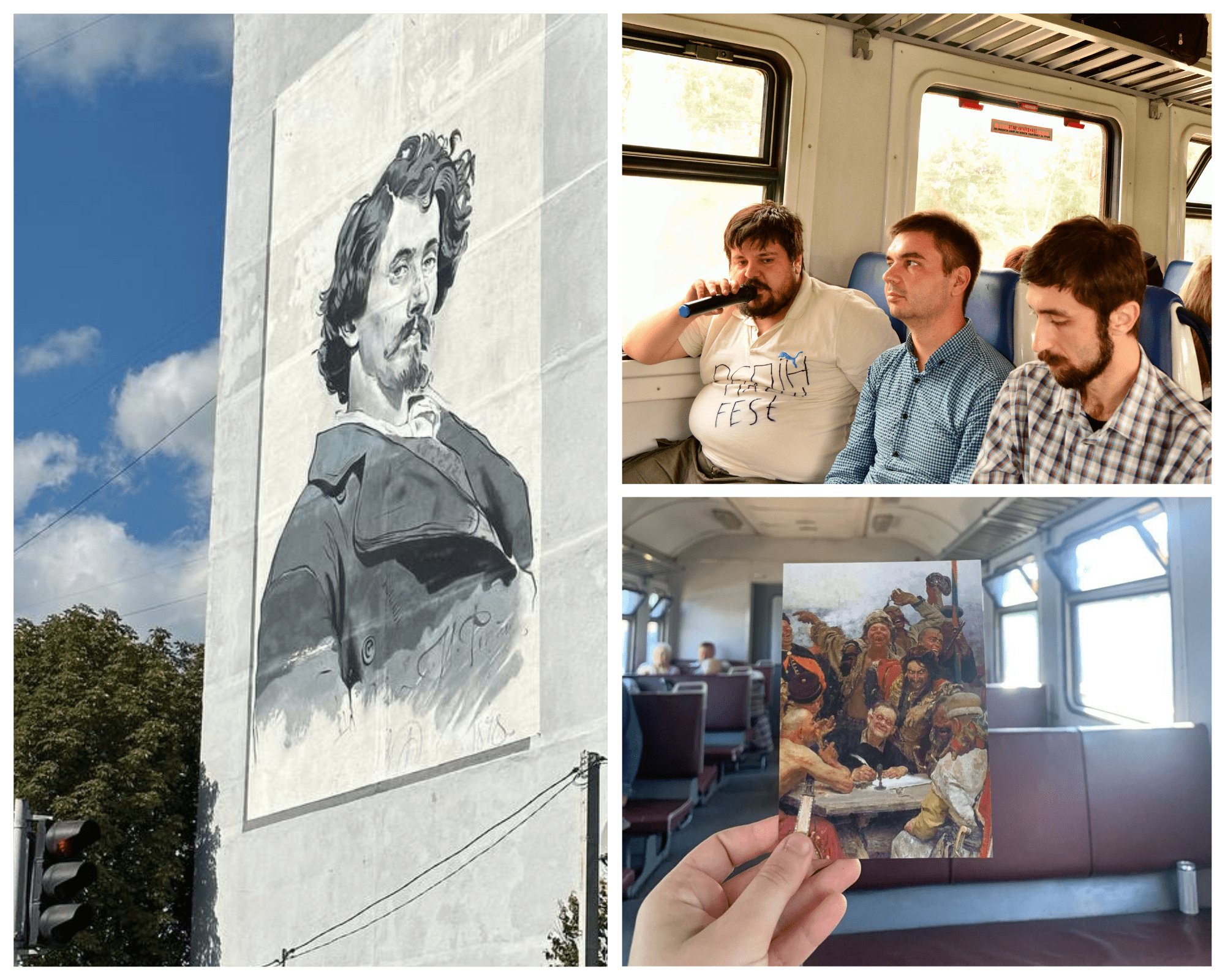
Every region had its festival coordinators, so every region was specific. Everywhere the main topic was a conversation about the artist initiated in the public transport by volunteers. For instance, they entered a car between Kyiv and Nizhyn, turned on speakers and a person with a microphone started talking about the festival, started a discussion about Repin, and invited passengers for a talk.
Everyone who has ever commuted by suburban trains knows these formats are loved there. In those trains, you can meet preachers and vendors, guitar or accordion players. People sell citric acid, playing cards, and socks. So, passengers willingly joined conversations about Repin. Yevhenii Shatilov, the festival’s coordinator, says people often took a microphone and started talking about Repin, and often they also told weird stories from their lives. Discussions about art and life (try to separate one from another) moved from car to car, and settled in tambours between the cars. So it had a real vibe of suburban train: carnival, sincere and genuine.
“It was interesting both as a performance and as a research on what people in those trains think about Ukrainian culture. And it also was half an education because we were talking about Repin’s personality, his role in Ukrainian culture. It’s interesting that in a train from Kharkiv to Chuhuiv people are aware of all this, a question whose Repin is not a question for them. He is ours, they have no doubts”, says Yevhenii. By the way, these talks were recorded and a podcast was made from them.
What will be tomorrow
When we asked Shatilov what was the main conclusion he got from the festival, he said the following:
“Often the conversations about culture, decolonization, and other high matters are locked within a small bubble. We, cultural managers, people from creative industries need to talk about culture not only between us. We need to talk for a wide audience”.
And there are things to talk about. No one is surprised now to hear that “Black Square” is a masterpiece of Ukrainian artist Kazymyr Malevich. Even being interrogated by the Soviet security officers in Leningrad he answered he was Ukrainian. We will be talking more about this. In the suburban trains and trams, on the streets, from Lviv and Kopychyntsi to Luhansk and Milove. These will be interesting talks and even more interesting walks.
The project “Young Diversity Ambassadors” is implemented by STAN NGO in partnership with the “Action Aid” alliance for rights, equality and international solidarity with the support of the Disasters Emergency Committee (DEC). Revitalization and insulation of the safe spaces for youth is implemented with the support of Global Fund for Children (USA) та terre des hommes (Germany).