


Communities of equal opportunities
18.11.24
Streets and public transport, shops, cafes, social centers, and institutions are the same for everyone. Naturally, they also have to be equally accessible to everyone. Unfortunately, this is not quite the case.
People using wheelchairs or crutches find it hard to get to certain spaces, much less feel comfortable in them. It is hard and uncomfortable to move along the sidewalks or cross the streets. This is also true for people with severe visual impairment, hearing loss, or other disabilities. Even if you have a rolling suitcase, getting to the railway station turns into an adventure.
Meanwhile, accessibility issues which have always been important, are getting even more relevant. Russia has invaded Ukraine. People are dying every day, some lose their limbs, vision, hearing… That happens both at the frontline and in the cities or villages that are deemed relatively safe.
What is the answer? Complaining that infrastructure is flawed and that everything is wrong won’t change the situation. We need to roll up our sleeves and work hard to make things right. Keep reading to learn what to do and with whom to work.
Accessibility for everyone
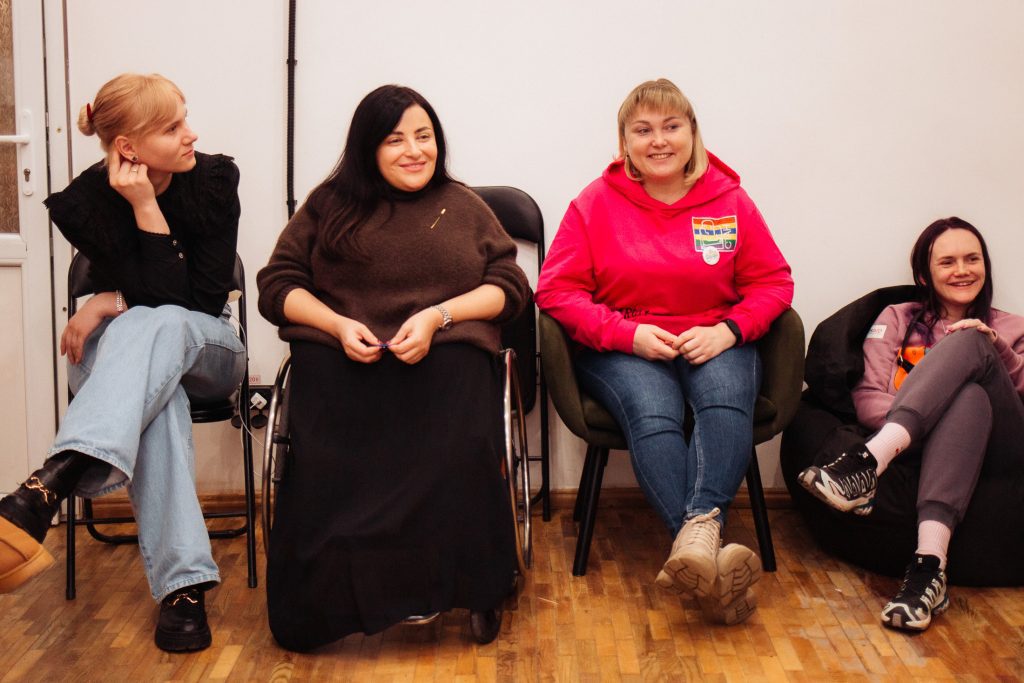
In our previous texts we told that after the introductory workshops of the “Young Diversity Ambassadors” program, the participants choose the topics they are willing to engage in. They deepen their knowledge at the highly specialized, and therefore, more extensive workshops. Some of these workshops are led together with the partners holding the expertise in certain areas. Young people interested in inclusion and accessibility are blessed with the opportunity to work with Chernivtsi Association “Zakhyst” experienced in the spheres of accessibility, inclusivity, human rights, and supporting vulnerable groups. The head of the organization, Maria Nikitina, is one of the most prominent experts in the field. She serves on the Accessibility Board of the Cabinet of Ministers of Ukraine, is an invited expert at the Accessibility Handbook project, etc.
Workshops “The Communities of Equal Opportunities, Inclusive Space, Democracy Tools” are currently being held in Chernivtsi, hosted by “Zakhyst”. The next one is planned for December 2024. From the experience of the previous workshops, we see that the participants come back from Chernivtsi full of inspiration. What is their secret? “We don’t limit the discussions of the inclusion and accessibility to the needs of people with disabilities,” Maria Nikitina explains. “It’s a wider idea, and when we explain it to young people, it gets more interesting for them. They realize that inclusivity and accessibility are also necessary for them, their friends, and colleagues.”
That’s true, accessible solutions are needed for pregnant women, parents with small children, people temporarily using crutches, and the elderly. It also goes for people with visual impairments, regardless of their severity, as everyone can damage or break their glasses. Accessible solutions prove helpful for people with hearing and speech disabilities. Imagine them requiring the help of police or firefighters: they need to write to a speaking person and ask them to call the respective services (and sometimes the trouble comes at night when all the friends are asleep). Or think about the travelers: with a rolling suitcase, you will stumble on all possible obstacles.
“Everything at the workshop was new to me,” Kir Nemichev says. “Maria answered all our questions, even the dumb ones coming from me. She was really patient with us, explaining everything about inclusive communication, hate speech, and inclusivity of our city (now I am walking the streets horrified).”
“First of all, I liked how the information was presented,” Nestor Bolshakov muses. “They were incredible. They found a fine line, when there is plenty of information, but still, there is a space for things you don’t know and strive to learn more about. And the delivery itself. Maria had a full-on stand-up comedy session, interspersing information with personal stories which I remember well. Overall they are really bright and friendly people.”
In addition to the theoretical lectures, ambassadors who came to the workshop in Chernivtsi also had an opportunity to test the city for accessibility. They moved on wheelchairs and walked with white canes. “My group learned how accessible Shevchenko Park across the Bukovyna hotel is,” Nestor says. “It was already hard to get out of the hotel to the crosswalk using a wheelchair. You need to cross the old tram rails, your wheels get stuck, and you can’t get out alone. You can’t make it to the crosswalk, because the pavement is damaged, so you need to get on the road. The head of the group also said that we needed to explore the public toilet in the park. So in I went. There is a WC for people with disabilities, but the doors and 60 cm wide, the narrowest of them all. And it’s cluttered by some junk: parrot statues, a steering wheel… Hard to get inside, hard to turn around. Oh, and to get inside, you would need a Philips screwdriver because the door was screwed. It sounds absurd, but I have the photos. It’s quite sad, actually.”
This approach helps to engage young people, encouraging them to act up. “It’s like a trigger for them,” Maria Nikitina explains. “They understand that it’s unacceptable, and changes are needed.” Nestor Bolshakov says after the workshop in Chernivtsi he perceives inclusivity and accessibility differently and now he wants to make changes in his city. “We plan to organize an informational advocacy campaign in Ivano-Frankivsk. We want to show that the city is not accessible, that many spaces aren’t. Even though the infrastructure was improved, it is not enough.”
How to make your space accessible
NGO “Zakhyst” provides counseling services for organizations, institutions, and communities willing to become more accessible. They work with medical facilities, holding workshops for the staff about working with disabled patients. They also test the hospital spaces and then prepare recommendations on what can be improved in terms of accessibility.
Here is another example. NGO “STAN” has recently established a new resource center for young people in Ivano-Frankivsk (soon we’ll tell more about it). Already at the renovations stage, Maria Nikitina conducted an audit of the facilities and the city space nearby, staying in touch with the construction workers and providing explanations. We asked her to tell us about this audit and things to consider.
“We create accessible solutions for all the population groups,” Maria says. “To focus, say, only on wheelchair accessibility is not enough.
Let’s move from the bus stop to the crosswalk, paying attention to the barriers. If there are any, we can write our recommendations to the city council. Approaching the building, we notice if there are parking spaces for drivers with a disability. Such parking spaces need to be no further than 50 m from the entrance, with an area of at least 3 x 5 m. This way it is easy to open the door and take away a wheelchair or another mobility aid.
Moving to the entrance now. If there are stairs, we advise installing a ramp: it has to be no narrower than 1.2 m and should feature double-height handrails. The ramp slope has to meet the requirements. If the stairs are higher than 1 m, it is advised to install a mini elevator or a platform lift.
The entrance to the building and the building itself also have to be accessible. The surface has to be flat. The doors should be 90 cm wide or more so that you can go through them using any wheelchair.
We need to pay attention to the tactile paving. Some are directional, guiding vision-impaired people along the way. Blister tactile is installed 40 cm before the change of direction. When people using a white cane sense this paving, they realize that ahead is an entrance to the building, a staircase, an elevator, a crosswalk, or a danger of some kind. The stairs with a ramp need to have yellow tactile indicators on the first and last steps (yellow is the only color that people with severe visual impairments can discern).
Next, we need to check the WCs. Toilet cabin needs to be at least 1.85 x 1.65 m, but preferably wider. It has to be easy to get to the toilet bowl using a wheelchair. It’s better to use flip-up grab bars. Not everyone uses them, but for many people, they may become an obstacle.
You shouldn’t put any cabinets under the basin, because it makes it more difficult to approach the basin. Mirrors should be tilted, which allows wheelchair users to see themselves. Coat hooks need to be no higher than 1.2 m, hooks for crutches or canes — no higher than 1.5 m. These hooks are really necessary, because without them mobility aids fall on the floor, and you need to pick them up.
You have to stick a yellow sign on the glass doors or any other transparent surfaces to warn people with severe vision impairments.
People with hearing disabilities need to be able to read all the information that other people hear. The workers of the space should remember they need to give the printed texts to the hearing-impaired people and show them around. When it comes to people with vision impairments, they should describe the space and talk to them.
If that’s a space where people spend a lot of time, like a cafe or a youth center, we need to care about comfort and safety. The less legs a table has, the better. This way, people using a wheelchair or crutches may sit down (multiple legs or barriers get in the way).
If there is a kitchen in a space then make sure that coffee, tea, and cups are available on both higher and lower shelves. This way, a person using a wheelchair can get everything they need for themselves.”
Of course, this recommendation list is far from being conclusive. Still, we can add one more piece of advice: focus on the accessibility of your space, don’t slack off, and don’t be shy to ask the experts for help. They will gladly advise and help you.
Suggestions instead of criticism
Many accessibility problems may be solved only in cooperation with the local government. However, sometimes it is hard to establish contact and make yourself heard, so we asked Maria Nikitina to share her experience. “You need to bring suggestions rather than criticism,” the expert says. “We plan every step, and only then do we address the local government. That is efficient. The time for the criticism comes only when suggestions don’t bring changes.”
Making informational campaigns together also works well. Maria explains that the local government is usually enthusiastic about raising awareness on important topics. It has several advantages. First of all, the audience is bigger. Another thing is, that after deeming the problem important, the local government won’t be able to dismiss it, saying that “it’s not the time.”
The project “A network for democracy: Building a future with the European leaders of tomorrow” is implemented by the NGO “STAN” and ActionAid in partnership with the NGO “Center for Social Transformations TENET”, NGO “Insight”, NGO “Chernivtsi Association “Zakhyst” with the support of the Danish Ministry of Foreign Affairs (Denmark). This project is a part of the program “Young Diversity Ambassadors”
This is a program for youth and youth workers to strengthen social cohesion to create an inclusive, peaceful society, minimize the likelihood of conflicts arising between different groups, and accelerate the integration of young IDPs. The program is implemented by the NGO “STAN” in partnership with the Alliance for Rights, Equality and International Solidarity “ActionAid” with the support of the Disasters Emergency Committee (DEC), Global Fund for Children (USA), Terre Des Hommes (Germany) and IM Swedish Development Partner (Sweden).